

For most Christian parents and homeschool educators, the strongest starting point is a family-friendly curriculum built on the Creation–Fall–Redemption–Restoration (CFRR) framework with age-tailored materials and integrated apologetics. Three programs stand out across different settings:
- Apologia "What We Believe" — best for families and grades 4–8; adaptable for co-ops and devotions
- BJU Press Biblical Worldview — best for upper middle and high school; strongest teacher support and assessments
- Foundation Worldview — best for younger children; story-driven and parent-led
Before you buy, preview sample lessons. You can also browse faith-based video content on Bonafice to find short clips that pair with any of these programs.
Pro Tip: Most publishers offer at least one free sample lesson or scope & sequence document. Download it before purchasing. The teacher notes alone will tell you whether the program fits your teaching style.
Key Takeaways
The strongest Christian worldview curricula pair the Creation–Fall–Redemption–Restoration framework with age-appropriate formats and integrated apologetics across subjects, not as a standalone class.
| Point | Details |
|---|---|
| Top picks by age | Apologia for grades 4–8, BJU Press for grades 8–12, Foundation Worldview for K–5. |
| Format fit matters first | A video-led or short-session program your child completes beats a rigorous textbook they abandon. |
| Preview before you buy | Download the free sample lesson and scope & sequence; check the teacher edition's middle chapters. |
| Integrate across subjects | Look for teacher notes that connect worldview concepts to history, science, and literature. |
| Bonafice as a supplement | Short video and audio content from Bonafice works as a lesson opener, discussion primer, or family devotion follow-up alongside any curriculum. |
Table of Contents
- How do the top Christian worldview curricula compare?
- How do you choose the right biblical worldview curriculum?
- Which curriculum fits which ages and settings?
- What does a Christian worldview curriculum actually teach?
- Does accreditation apply to Christian worldview curricula?
- What do other families say about these programs?
- What the conventional advice on worldview curricula gets wrong
- Bonafice pairs well with any worldview curriculum
- Where to preview curricula and learn more
- Sources
How do the top Christian worldview curricula compare?
The three programs below cover the same core territory — biblical worldview, apologetics, and CFRR — but differ sharply in grade fit, format, and how much they ask of the teacher.
Apologia's worldview series includes four volumes: Who is God?, Who Am I?, Who Is My Neighbor?, and What On Earth Can I Do? Most families complete one volume per school year, which makes the pacing manageable alongside other subjects. The program is explicitly designed for family use, so a parent with multiple children at different grade levels can teach it together without splitting the group.

BJU Press takes a more academic approach. Student texts, teacher editions, activity manuals, and digital assessments are all included. The program is built to prepare students to articulate and defend Christian beliefs — not just understand them. That makes it the right call for a high schooler who needs to engage secular arguments at college level.
Foundation Worldview leads with video instruction, which lowers the preparation burden for parents who are not confident teaching worldview concepts from scratch. The trade-off is less depth on apologetics compared with BJU Press.
Trust signals to look for in any program:
- A published scope & sequence document (not just a table of contents)
- A teacher edition with discussion prompts, not just answer keys
- Named author or publisher credentials tied to a theological tradition
- Sample lessons available before purchase
- Clear grade-level alignment with stated learning objectives
Pro Tip: When you preview a teacher edition, flip to the middle of the book — not the first lesson. Publishers put their best material at the start. The middle lessons show you the real pacing, depth, and how much the teacher is expected to prepare.
How do you choose the right biblical worldview curriculum?
Use this checklist before committing to any program.
- Define your learning outcomes first. Do you want your child to understand the CFRR framework, defend the faith in conversation, or apply a biblical lens across school subjects? Each goal points to a different program.
- Match the format to your schedule. A video-based program works for a family with 20 minutes per day. A textbook-heavy course needs 45–60 minutes and a parent who can facilitate discussion.
- Confirm the grade-level alignment. Check the publisher's stated age range against your child's reading level, not just their age. A mature 7th grader may be ready for BJU Press; a struggling 9th grader may need Apologia first.
- Check the theological approach. Reformed, Arminian, and broadly evangelical programs all use CFRR, but they differ on free will, election, and cultural engagement. Know where your family stands.
- Decide on apologetics depth. Devotional programs build faith and identity. Evidential apologetics programs (like BJU Press) train students to reason through objections. High schoolers heading to secular colleges need the latter.
- Evaluate teacher support. A teacher edition with lesson plans, discussion questions, and assessments saves hours of preparation. A program with only a student text puts all the work on you.
Questions to ask before you buy:
- Is there a free sample lesson or scope & sequence available?
- Does the teacher edition include discussion prompts and assessments, or just answer keys?
- Is the license for co-op use, or is it single-family only?
- What is the recommended class time per lesson?
- Are digital resources included, or purchased separately?
Red flags to watch for:
- No sample lesson available anywhere on the publisher's site
- Grade alignment described only as "ages 8–18" with no further breakdown
- Teacher support limited to a single-page answer key
- Theological framing described as "non-denominational" with no further explanation
- No author credentials or doctrinal statement listed
Which curriculum fits which ages and settings?
Elementary (grades K–5)
At this stage, the goal is foundational story and identity — not argument. Children need to know who God is, who they are in Christ, and that the Bible tells one coherent story. Foundation Worldview's video-led lessons and Apologia's Who is God? and Who Am I? volumes both work well here. Keep sessions short (15–20 minutes), story-rich, and discussion-based.
- Home use: Parent reads aloud, children narrate back or draw responses in a notebooking journal.
- Co-op: Rotate the video lesson as the group opener, then break into small discussion groups by age.
Middle school (grades 6–8)
This is the right time to introduce basic apologetics and cultural engagement. Students can handle the question "Why do you believe that?" and need practice answering it. Apologia's Who Is My Neighbor? and What On Earth Can I Do? fit here, as does Rooted Ministry's 10-lesson Biblical Worldview study, which walks through Creation, Fall, Redemption, and Glorification in a compact sequence designed for middle-to-high school clarity.
- Home use: Assign reading independently, then discuss at dinner or in a weekly session.
- Co-op: Use the Rooted Ministry lesson outline as a semester elective — 10 weeks, one lesson per week.
High school (grades 9–12)
Depth and defense matter here. BJU Press is the strongest option for students who need to articulate and defend Christian beliefs against secular objections. Pair the textbook with short evidential apologetics media. The Cold-Case Christianity video series models investigative reasoning applied to Gospel claims and works well as a media supplement for this age group.
- Home use: Student reads independently; parent or teacher facilitates weekly Socratic discussion.
- Classroom or co-op: Use BJU Press assessments as formal grades; assign apologetics clips as pre-class viewing.
Mixing formats across ages: Print + video + short apologetics clips is the most effective combination for most households. Video holds attention and models argument; print builds retention; short clips (under 5 minutes) prime discussion without eating lesson time.
What does a Christian worldview curriculum actually teach?
A Christian worldview curriculum is a structured program that teaches students to interpret all life — history, science, ethics, culture, relationships — through the lens of Scripture. It answers four foundational questions, drawn from Dallas Willard's framework:
- What is real? (the nature of God, creation, and the physical world)
- What counts as knowledge? (how we know what we know — revelation, reason, experience)
- Who is well-off? (what the good life looks like under God)
- What makes a person good? (character, virtue, and moral formation)
The CFRR framework organizes these answers into a four-act story: God creates a good world (Creation), humanity breaks relationship with God (Fall), Christ restores what was broken (Redemption), and God will one day make all things new (Restoration). Most quality programs use this arc to teach students how to evaluate any cultural issue — gender, government, technology, justice — through a biblical lens.
A typical lesson in a quality program includes a scripture passage, a discussion prompt, a case study or cultural application, a short apologetics mini-lesson, and an assessment or reflection activity. Delivery formats range from print textbooks and eTexts to video lessons and teacher editions with full lesson plans.
Does accreditation apply to Christian worldview curricula?
Accreditation is not a standard requirement for worldview curricula used in homeschool or family settings, and most programs do not carry formal accreditation. What matters more is whether the program aligns with a recognized theological tradition and whether the publisher provides a clear doctrinal statement.
For classroom use in a private Christian school, check whether the school's accrediting body (such as ACSI or Cognia) recognizes the curriculum as meeting Bible or worldview credit requirements. BJU Press materials are widely used in ACSI-accredited schools and are generally accepted for Bible credit at the high school level. Apologia is similarly recognized in many homeschool transcript systems.
For homeschool families, state requirements vary. Most states do not regulate worldview or Bible content specifically, but if you need to document the course for a transcript, confirm that the program lists clear learning objectives and provides assessments you can use as evidence of completion.
What do other families say about these programs?
Apologia's "What We Believe" series consistently draws positive feedback from homeschool families for its flexibility and family-friendly tone. Parents frequently note that the notebooking journal keeps younger children engaged and that the program adapts well to mixed-age households. The publisher's own product pages reflect strong community adoption across co-op settings.
BJU Press receives high marks from educators and co-op teachers for the depth of its teacher edition and the quality of its assessments. Families who have used it for high school report that students arrive at college better prepared to articulate their faith under pressure. The trade-off noted most often is that the program requires consistent preparation time from the teacher.
Foundation Worldview is frequently recommended by parents of younger children who want a video-led option that does not require the parent to be a trained teacher. The program's story-driven approach resonates with children in the K–5 range, and parents report high completion rates compared with text-heavy alternatives.

Short apologetics media supplements, such as The Gospel Coalition's "One Minute Apologetics" clips, are widely cited by teachers and co-op leaders as effective discussion starters — concise enough to hold attention and focused enough to prime a single conversation.
What the conventional advice on worldview curricula gets wrong
Most buying guides for Christian worldview curriculum focus almost entirely on theological alignment — Reformed vs. Arminian, young-earth vs. old-earth, presuppositional vs. evidential apologetics. Those distinctions matter, but they are not the first question to answer.
The first question is format fit. A theologically perfect curriculum that your child never finishes is worse than a good-enough program they complete. Busy families consistently underestimate how much a video-led or short-session format increases follow-through. Apologia's family-adaptable design and Foundation Worldview's video instruction exist precisely because publishers learned this lesson from completion data.
The second overlooked factor is integration. Worldview education fails when it lives only in a single class period or a weekly devotion. The Dallas Willard framework makes this explicit: a worldview should function as a lens across every subject, not a subject unto itself. The best programs provide teacher notes that show how to connect worldview concepts to history, science, and literature lessons the student is already taking. If a program's teacher edition has no cross-subject integration notes, that is a real gap — not a minor omission.
Finally, most guides treat apologetics as an advanced add-on for high schoolers only. That is too late. Middle schoolers are already encountering secular arguments on social media and in peer conversations. A program that introduces basic evidential reasoning at grades 6–8 gives students two to three years of practice before the stakes get higher.
Bonafice pairs well with any worldview curriculum
Choosing a strong curriculum is the right first step. Keeping students engaged across a full school year is the harder part. That is where Bonafice fits in.
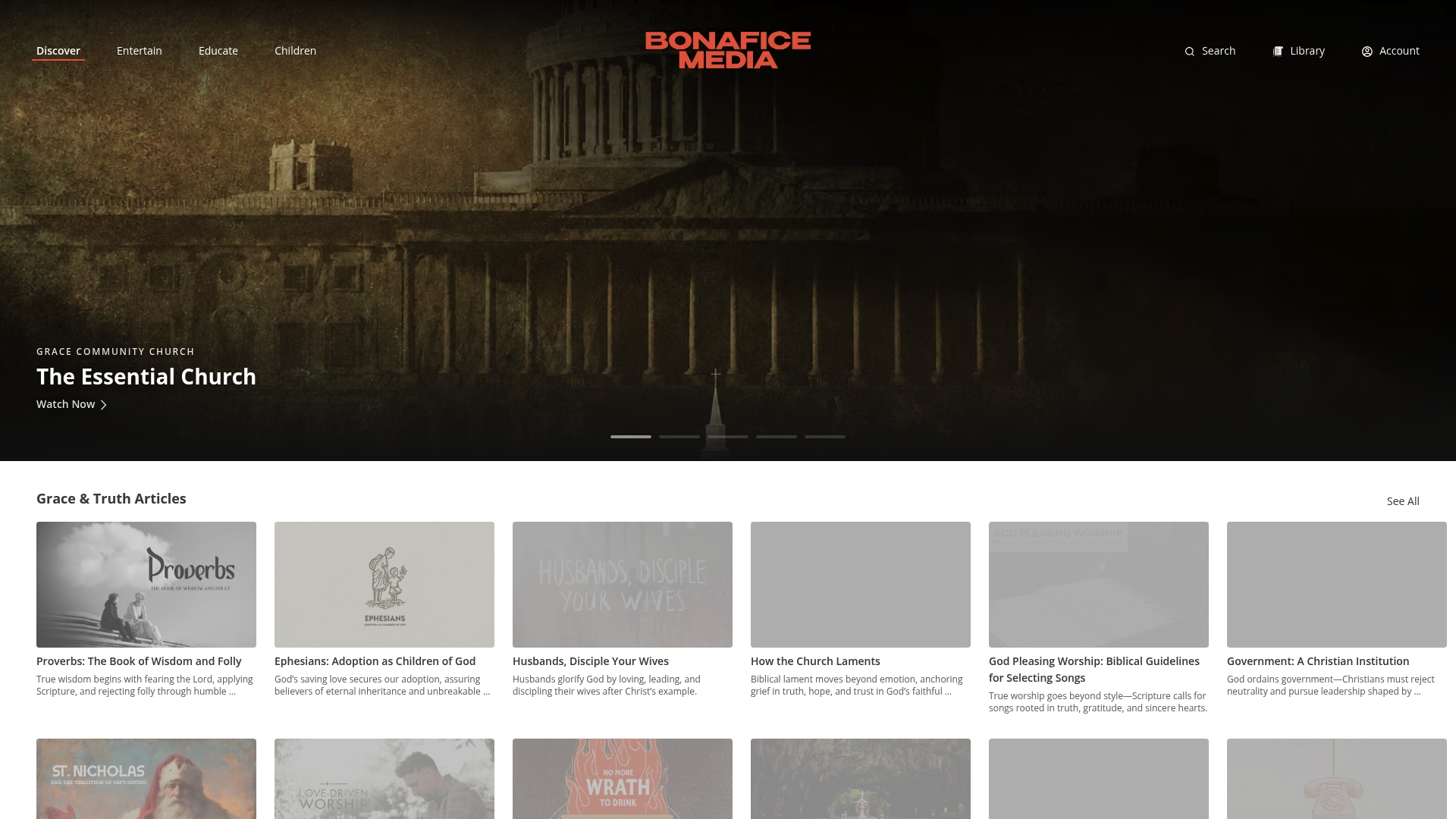
Bonafice is a family-focused digital media platform offering short Christian video series, audio content, ebooks, and podcasts built around faith, education, and family discussion. You can use a Bonafice clip as an opening devotion to set the lesson's theme, as a case-study video mid-lesson to ground an abstract concept, or as a family follow-up after dinner. For middle and high school students, short apologetics-adjacent video content from the platform works as a pre-class primer that primes discussion without replacing the curriculum. Preview a clip or start a trial at Bonafice and see which series fits your current unit before you commit to a full curriculum purchase.
Where to preview curricula and learn more
Before purchasing any program, spend 20 minutes on the publisher's sample pages. Here is what to look for and where to find it.
Publisher preview pages:
- Apologia Worldview — sample pages, volume descriptions, and co-op guidance for the "What We Believe" series
- BJU Press Biblical Worldview — course overview, teacher edition details, and assessment descriptions
- Rooted Ministry Biblical Worldview Curriculum — free 10-lesson CFRR outline with lesson titles, scripture passages, and discussion questions; useful as a standalone middle/high school elective or as a preview of how a quality lesson sequence is structured
- Dallas Willard on Worldviews — foundational primer on the four core worldview questions and the CFRR teaching pattern; useful for understanding what any curriculum should be doing before you evaluate whether it does it well
What to look for in a sample lesson:
- A clear scope & sequence listing every lesson title and its scripture anchor
- Teacher notes that go beyond answer keys — look for discussion prompts and cross-subject connections
- Age-appropriate tone (a sample written for a 5th grader should not read like a seminary textbook)
- At least one apologetics element, even in elementary programs — a question like "Why do we believe the Bible is true?" is enough at that level
- Assessment options that match your setting (written responses for homeschool, group discussion rubrics for co-ops)