The right homeschool Bible curriculum depends on three things: your kids’ ages, how much structure your family needs, and whether you want apologetics built in from the start. Here is the short list.
-
Multi-age family (K–8): A chronological whole-Bible kit covers the full narrative arc, keeps siblings learning together, and typically includes a parent guide, student pages, and a clear scope and sequence. Look for one with a published doctrinal statement and free sample lessons before you buy.
-
Preschool and early elementary: A literature-based package pairs picture books and read-alouds with Scripture memory, making Bible time feel natural rather than academic.
-
Visual and kinesthetic learners: A video-driven Bible program with short animated or live-action segments and a notebooking guide works well when kids need motion to retain memory work.
-
Middle and high school apologetics track: An apologetics-focused curriculum introduces defense-of-faith reasoning by middle school and deepens it through high school, preparing students for college and cultural engagement.
-
Academic Bible credit (high school): A structured, credit-bearing theology or Bible survey course with tests, a teacher guide, and a scope and sequence document you can attach to a transcript.
-
Media supplement for any model: Bonafice provides on-demand Christian audio, video, and ebooks that pair with any of the above for family devotions, memory-verse review, and short apologetics clips.
Three trust signals to check before committing to any curriculum: a published scope and sequence, access to at least one free sample lesson, and a clear worldview or doctrinal statement from the publisher.
Key Takeaways
The most effective homeschool Bible curriculum combines a structured, scope-and-sequence-driven program with daily media reinforcement that keeps Scripture present beyond the formal lesson block.
| Point | Details |
|---|---|
| Match model to age and rhythm | Chronological kits suit multi-age families; video-driven programs fit visual learners in K–6; apologetics tracks belong in grades 9–12. |
| Verify three trust signals | Confirm a published scope and sequence, at least one free sample lesson, and a clear doctrinal statement before purchasing any curriculum. |
| Budget for consumables | Base kit price rarely covers the full annual cost; add workbooks, replacement journals, and any streaming fees to get the real number. |
| Document high-school credit | Log course title, curriculum used, weekly hours, and assessment scores; 120 hours earns 1.0 transcript credit. |
| Supplement with Bonafice | Bonafice’s faith-first media catalog reinforces Bible learning during devotions, car rides, and family time beyond the formal school block. |
Table of Contents
How do the top homeschool Bible curriculum models compare?
The five major curriculum models differ most on format, what is physically included, and how they handle apologetics. The table below maps those differences across the dimensions that affect your daily schedule and your budget.
| Best for / Use case | Grade range | Approach | What’s included | Format | Apologetics / worldview | Purchasing model | Sample preview | Weekly minutes |
|---|---|---|---|---|---|---|---|---|
| Multi-age families | K–8 | Chronological whole-Bible | Teacher guide, student pages, tests, memory work | Print + digital PDF | Strong; introduced early, deepened by grade 4+ | Per-grade kit or multi-year bundle | Free sample pages on publisher site | half an hour to three-quarters of an hour daily |
| Early readers, story-driven learners | PreK–5 | Literature-based + Bible integration | Read-aloud lists, narration prompts, Scripture memory cards | Worldview woven into literature discussion | Package per year level | Sample chapters downloadable | about twenty to thirty minutes per day | |
| Visual / kinesthetic learners | K–6 | Video-driven Bible program | Streaming video lessons, notebooking journal, activity guide | Streaming + print | Memory-verse motion tools; worldview introduced mid-elementary | Subscription or per-level purchase | Free streaming preview clip | about twenty to thirty minutes per day |
| High school students | 9–12 | Apologetics-focused track | Student text, teacher guide, tests, discussion questions | Print + digital | Explicit apologetics; defense-of-faith coursework | Per-course purchase | Sample unit downloadable | forty-five to sixty minutes daily |
| Families wanting one spine | K–12 | Multi-age family Bible kit | Core reader, age-differentiated activity pages, parent guide | Worldview integrated throughout; apologetics by grade 7 | Annual kit or subscription | Free scope & sequence + sample lesson | half an hour to three-quarters of an hour daily |
Publisher websites commonly offer sample lessons and downloadable scope and sequence documents so you can preview content before buying a full kit.
Before you buy, check these three things on any sample lesson:
-
Does the lesson align with your family’s theological convictions? Read the publisher’s doctrinal statement, not just the marketing copy.
-
Is the parent guide clear enough that you can teach it without extra prep?
-
Are consumables (workbooks, notebooking journals) included in the kit price, or sold separately?
Free options also exist. Some community-driven curricula provide a full 180-day structure across subjects including Bible, available at no cost, which makes them a low-risk way to test a chronological or integrated approach before investing in a paid kit.
What does each curriculum model actually give your family?
Chronological whole-Bible kit
Who it fits: Families with multiple children across K–8 who want one spine that covers the entire Bible in sequence. Works well for structured, teacher-led households.
Typical grade range: K–8, often in a four-year repeating cycle.
What’s included: Teacher guide, student activity pages, tests or quizzes, memory-work cards. Some kits add timeline visuals and maps.
Extra costs: Consumable student pages must be repurchased each year per child. Expect some additional annual cost per student beyond the base kit.
Time commitment: a daily session lasting about thirty to forty-five minutes.
Apologetics placement: Chronological curricula aim to teach the whole Bible in sequence and often include apologetics material to support belief in biblical historicity, typically introduced in the early grades and deepened by grade 4 or 5.
-
Pros: Strong narrative continuity; multi-age friendly; apologetics built in from the start.
-
Cons: Repeating cycle means older kids revisit early-grade content; consumables add up.
Literature-based + Bible integration
Who it fits: Families who already use a literature-based approach to history and want Bible woven in rather than taught as a separate subject.
Typical grade range: PreK–12, with planned progression from joyful discovery in early grades to apologetics and worldview at the high-school level.
What’s included: Curated read-aloud lists, narration prompts, Scripture memory cards, and a parent guide. Literature-based programs scaffold Bible exposure from early discovery to apologetics at the high-school level.
Extra costs: Books on the read-aloud list are sometimes sold separately.
Time commitment: 20–30 minutes of dedicated Bible time, plus incidental integration during history and literature blocks.
-
Pros: Bible feels organic, not bolted on; strong for verbal learners and narrators.
-
Cons: Less systematic for families who want a standalone Bible course with tests.
Video-driven Bible program
Who it fits: Visual and kinesthetic learners in K–6 who retain information better through motion and short video segments.

Typical grade range: K–6.
What’s included: Streaming video lessons, motion-based memory aids, and activity journals to support multi-modal learning. Most programs pair a notebooking journal with each video unit.
Extra costs: Streaming subscription fee if videos are not included in the base kit; replacement notebooking journals per child.
Time commitment: a daily session lasting about twenty to thirty minutes, including video and follow-up activity.
-
Pros: High engagement for young learners; memory-verse retention is strong with motion tools.
-
Cons: Requires reliable internet for streaming; worldview depth is lighter than dedicated apologetics tracks.
Pro Tip: Video and motion-based memory tools increase retention for elementary learners when paired with short daily practice and a discussion prompt at the end of each session. Keep a simple question ready: “What did God do in today’s story, and why does it matter?”
Apologetics-focused high-school track
Who it fits: Students in grades 9–12 preparing for college or public engagement with secular worldviews.
Typical grade range: 9–12.
What’s included: Student text, teacher guide, tests, and discussion questions. Some courses add primary-source readings and essay prompts.
Extra costs: Supplemental reading lists may require additional book purchases.
Time commitment: 45–60 minutes per session, 3–5 days per week.
Apologetics placement: Educational practice guidance for faith-based programs suggests introducing apologetics foundations by middle school and fuller defense-of-faith coursework in high school. This model delivers that full-depth track.
-
Pros: Prepares students to defend their faith with reasoned arguments; credit-bearing for transcripts.
-
Cons: Not suitable for younger students; requires a parent comfortable with discussion-based teaching.
Multi-age family Bible kit
Who it fits: Families with children across a wide age span who want one core lesson with differentiated follow-ups.
Typical grade range: K–12, with a single core reading and age-tiered activity pages.
What’s included: Full K–12 scope-and-sequence documents, parent teacher guides, printable resources, and multi-age lesson designs to support family teaching. Most kits include a core reader plus separate activity pages by level.
Extra costs: Printable consumables per child; some kits charge per level for activity pages.
Time commitment: 30–45 minutes for the core family lesson; 10–15 additional minutes for differentiated follow-ups.
-
Pros: One prep, multiple levels; builds family worship continuity; reduces parent planning time.
-
Cons: Differentiated pages add cost; high-school students may need a separate apologetics supplement.
Bonafice as a media supplement
Any of the five models above can pair with Bonafice’s catalog of Christian audio, video, and ebooks. Practical use cases include: short apologetics video clips for middle and high school review, memory-verse audio for younger kids during car rides, family devotion read-alouds from the ebook library, and animated Bible story series for preschool and early elementary. It is not a standalone curriculum. It works alongside a structured program to fill the gaps between formal lessons.
How do you choose the right Bible curriculum for your homeschool?
Start with five questions. Your answers will eliminate most options before you ever request a sample.
-
What is your grade goal? A preschooler needs joyful exposure. A 10th grader needs credit-bearing rigor. Match the curriculum’s stated grade range to where your child actually is.
-
What is your family’s daily rhythm? A 20-minute slot fits a video-driven or literature-integrated model. A 45-minute block supports a chronological kit or apologetics track.
-
What is your theological fit? Read the publisher’s doctrinal statement before the product description. Differences in creation, eschatology, and baptism matter for long-term curriculum use.
-
What pedagogical approach works for your child? Narrators and readers do well with literature-based models. Hands-on learners need video and activity journals. Structured test-takers fit chronological kits.
-
What is your total budget? Base kit price is rarely the full cost. Add consumables, replacement workbooks, and streaming fees to get the real annual number.
Selection checklist for sample-lesson review:
-
Scope and sequence document is available and covers your child’s grade level
-
Parent guide is clear enough to teach without additional training
-
Doctrinal statement is published and matches your convictions
-
At least one free sample lesson is available before purchase
-
Consumable costs are itemized separately from the kit price
-
Apologetics content is present and placed at the right grade level for your child
Red flags to watch for:
-
No scope and sequence document available
-
Parent guide is missing or requires a separate purchase
-
Doctrinal statement is vague or absent
-
No sample lessons offered before purchase
-
Hidden consumable costs discovered only after buying the base kit
Priority order for typical households:
-
Multi-age families: prioritize a single-spine kit with differentiated activity pages and a clear parent guide.
-
Single-grade families: prioritize scope and sequence alignment and sample-lesson quality.
-
College-prep high schoolers: prioritize credit documentation, test structure, and apologetics depth.
How do you implement a Bible curriculum in your homeschool?
Four-step start-up plan: preview a sample lesson, schedule your weekly blocks, adapt the pacing to your child’s level, and assess retention at the end of each unit.
Step 1: Preview. Download at least one sample lesson and teach it before you buy. Note where your child engages and where attention drops.
Step 2: Schedule. Assign Bible to a fixed daily slot. Morning works best for most families because it sets the tone before other subjects.
Step 3: Adapt. Adjust the lesson pace in the first two weeks. Most curricula assume 30–45 minutes; your child may need 20 or 60. Mark the parent guide accordingly.
Step 4: Assess. Use the curriculum’s built-in tests or quizzes at the end of each unit. For high school, keep a record of scores for transcript documentation.
Sample weekly timetable
| Setup | Mon | Tue | Wed | Thu | Fri |
|---|---|---|---|---|---|
| Preschool + elementary (multi-age) | Core read-aloud + memory verse (30 min) | Video lesson + activity (20–30 minutes) | Family discussion + narration (20 min) | Memory review + craft (20–30 minutes) | Review game + prayer (20 min) |
| Elementary only (block schedule) | Lesson + student pages (30–45 minutes) | Memory work + quiz prep (20 min) | Video or read-aloud (30 min) | Written narration (20–30 minutes) | Unit test or project (40 min) |
| Middle/high (credit-based) | Reading + notes (45–60 minutes) | Discussion questions (45 min) | Apologetics reading (45–60 minutes) | Essay or test prep (45 min) | Written assessment (45–60 minutes) |
High-school credit checklist
To document Bible study as a transcript credit, keep a course log that includes: course title, textbook or curriculum used, weekly hours, and assessment scores. A full credit requires a commonly recognized amount of weekly hours and assessments, with half credit generally accepted for about half that time. Combining an apologetics track with a theology survey in the same year is a common way to reach the 120-hour threshold for a full credit.
Multi-age teaching tips: Use one core family read-aloud as the anchor, then send younger children to an activity page while older students write a narration or answer discussion questions. Rotate who leads the closing prayer or memory-verse recitation among older kids. It reduces your prep and builds their confidence.
Pro Tip: Assign an older sibling to lead the memory-verse review two days per week. It reinforces their own retention, gives younger kids a peer model, and frees 10 minutes of your teaching time for one-on-one work with a struggling student.
Bonafice pairs with any Bible curriculum you choose
Most families spend months researching curricula and far less time thinking about what fills the gaps between formal lessons. That is where Bonafice fits. It is a subscription-based digital catalog of family-friendly Christian audio, video, and ebooks, built specifically for devotional and educational use in family and homeschool settings.
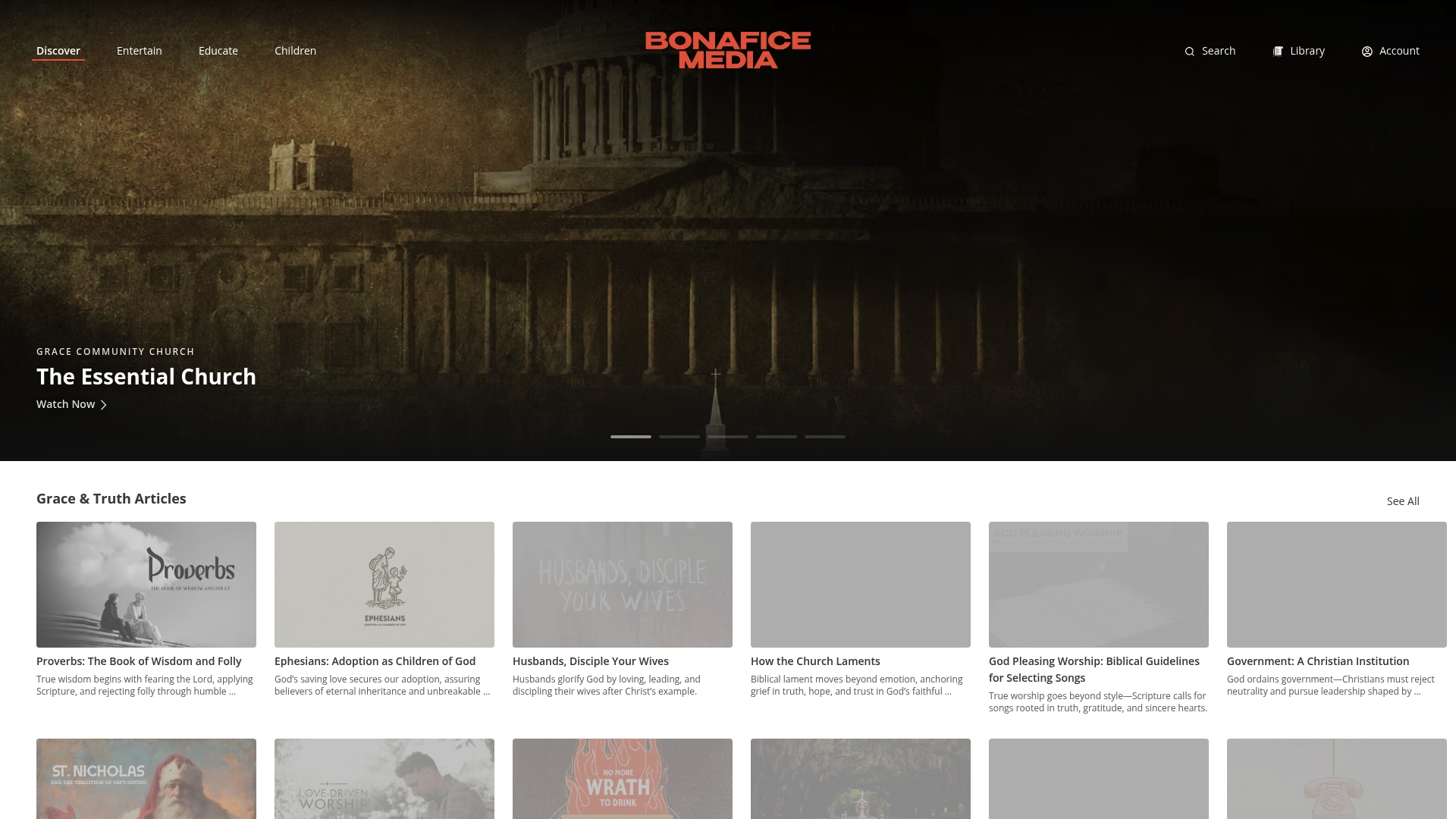
Concrete use cases: play a short apologetics video clip after your high schooler’s reading day, use a memory-verse audio track during the morning drive, read an ebook aloud during lunch for younger kids, or queue a Bible story series for preschoolers while you prep the day’s lesson. Before sharing account access with children, review the privacy policy and terms of service to understand data practices and permitted use for family accounts.
Preview a clip or start a trial at Bonafice to see how the catalog fits your current curriculum before committing to a subscription.
Why Bible-first curricula paired with quality media matter
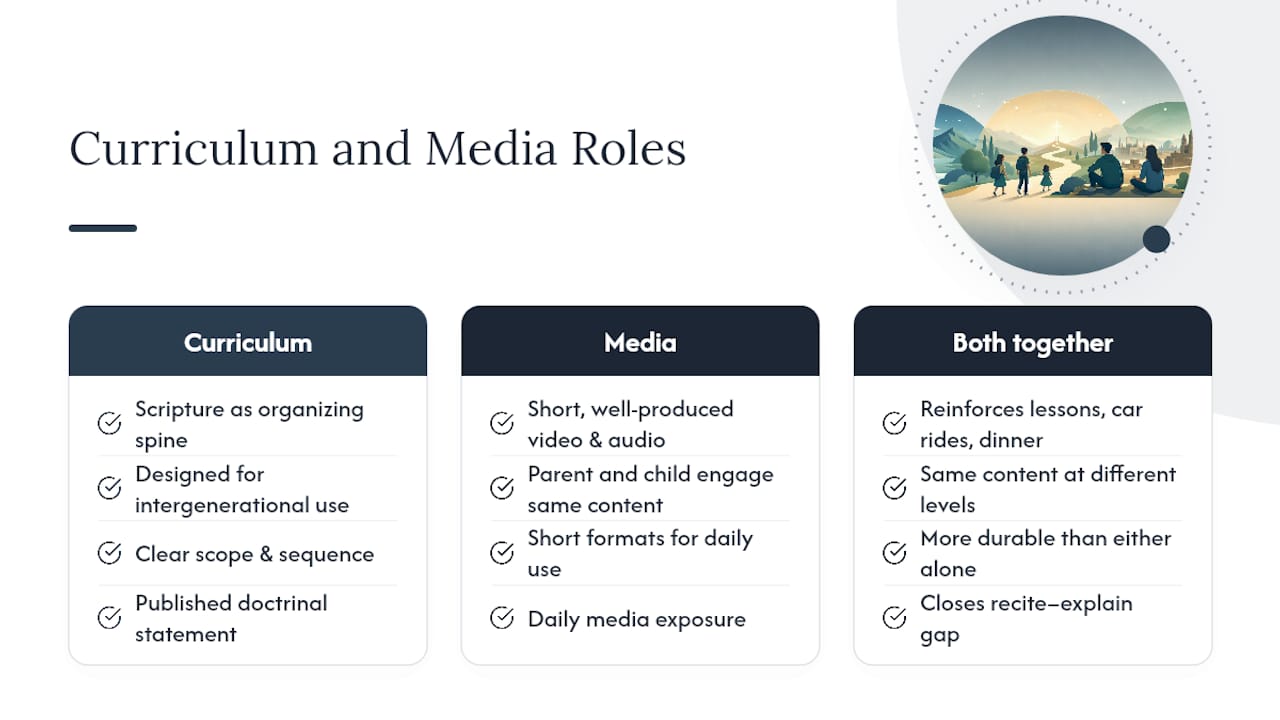
The strongest homeschool Bible programs share one trait: they treat Scripture as the organizing spine of education, not a subject slotted between math and spelling. Bonafice’s catalog is built around that same conviction. Every series, ebook, and audio program in the library is designed for intergenerational use, which means a parent and a six-year-old can engage the same content at different levels of understanding.
What most curriculum guides underestimate is the gap between a child who can recite a memory verse and one who can explain why it matters. That gap closes when formal curriculum and daily media exposure work together. A well-chosen chronological kit builds the narrative framework. Short, well-produced video and audio content reinforces it between lessons, during car rides, and at the dinner table. Neither alone is as durable as both together.
The editorial position here is direct: choose a curriculum with a clear scope and sequence, a published doctrinal statement, and free sample lessons. Then supplement it with media that keeps faith present outside the formal school block.